An RFID hotel key card is a CR80 card, 85.6 × 54 mm and 0.76 mm thick, carrying a 13.56 MHz or 125 kHz credential that your door locks already expect. We produce them for Caribbean resorts in recycled PVC, natural wood and paper-based fibre, from 500 pieces, in 14 to 21 days after artwork approval. The card body is a design decision. The credential inside it is a technical one, and it comes first: we confirm the installed system, chip tier and encoding requirement before any card goes to production.
The artwork is visible. The technical decision underneath it matters more.
Card dimensions alone do not establish compatibility. The installed system, credential technology and encoding workflow must be confirmed before production.
Once the technical specification is stable, the card can be developed around brand colour, handling, presentation and any approved variable information.
Specification
Hotel key card specification
Standard RFID hotel key card platform
Card format
CR80, 85.6 × 54 mm
Card body thickness
0.76 mm
High-frequency option
13.56 MHz, ISO/IEC 14443
Low-frequency option
125 kHz
Chip tiers
Entry HF, standard HF, high-security HF or AES-secure HF — tier selected from the confirmed system requirement
Card body materials
Recycled PVC, natural wood or paper-based fibre
Print and finish
Full-colour print with matte, gloss, natural or tactile finish directions
Variable data
Sequential numbering, barcode or approved variable fields
Minimum order quantity
500 pieces
Production time
14–21 days after artwork approval
Compatibility
Confirmed against the installed system, credential and encoding requirement before production
Figures describe the standard product platform. Chip tier, finish, closure and delivery scope are confirmed per property; compatibility is never assumed from the table alone.
How to confirm what your locks actually need
Card dimensions tell you nothing about compatibility. The most common mistake we see in enquiries is ordering by frequency alone: two properties can both run 13.56 MHz locks and still need different cards, because the locks read different chip generations, different memory layouts, or only the card’s serial number. There are three layers to confirm, in order.
1. Frequency. Older installed bases in the Caribbean often run 125 kHz low-frequency locks; most systems installed in the last decade read 13.56 MHz high-frequency cards under ISO/IEC 14443. A card on the wrong frequency is not "less compatible". It is invisible to the reader. If you are unsure which you have, the lock’s install date is a rough guide and a sample card is a definitive one.
2. Chip tier. Within 13.56 MHz there are entry-level chips, standard chips with writable memory sectors, and high-security tiers with AES encryption. Some properties genuinely need the AES tier because the lock system authenticates against protected keys. Others pay for security their locks never use. We select the tier from the confirmed system requirement, not from a default, which is why the specification table above lists tiers rather than a single chip.
3. Encoding method. Some access systems write room and validity data to the card’s memory sectors at the front desk. Others, including several cloud-based platforms, enrol cards by their fixed serial number only and store everything else server-side. The difference decides whether cards can ship pre-encoded, whether your front desk needs an encoder, and which memory configuration the chip must have. Our key-card encoding guide covers the workflows in detail.
The fastest route through all three layers is physical: courier us two working cards from your current stock. We identify the frequency, chip family and memory layout from the samples and return a written specification for your lock vendor to confirm. Where no sample exists, the system make and model plus a photo of the lock and front-desk encoder usually gets there. The full process is described in our compatibility confirmation guide.
One distinction worth stating because it comes up in real enquiries: your guest-room management system is not your credential. A GRMS controls lighting, climate and presence detection inside the room. The key card talks to the lock. They are supplied by different vendors more often than not, and naming the GRMS in an enquiry tells us nothing about which card your doors read. The lock system name is the one we need.
Recycled PVC, wood and paper fibre compared
All three card bodies carry the same credential options and the same CR80 format. They differ in feel, print behaviour, service life and the documentation behind their sustainability claims.
Card body materials compared
Recycled PVC
Natural wood
Paper-based fibre
Construction
Laminated recycled-content PVC body
Veneer body with embedded inlay
Compressed wood-pulp fibre board
Hand feel
Standard plastic card
Visible grain, matte, warm
Dry, matte, lightweight
Print
Full-colour offset or digital, matte or gloss
Print and engraving on natural grain
Full-colour print, matte
Humidity and pool exposure
Unaffected by humidity; handles wet handling
Surface-treated for tropical humidity; not for submersion
Suited to controlled, dry issue cycles
Typical service life
Longest of the three; survives repeated reissue
Season-scale with proper finish
Short-cycle; issue and retire
Sustainability documentation
Recycled-content share per supplier specification
Species and sourcing per approved specification
Fibre source and recyclability per specification
Typical fit
High-turnover resorts, wet environments
Brand-led properties seeking a premium natural feel
Short programs, conference blocks, trial runs
A note on how to read that table. The sustainability rows say "per specification" because we treat environmental claims as document-dependent. Recycled content, wood species, fibre certification and end-of-life statements are only worth what the supplier documentation behind them supports, and we put that documentation in front of you during specification rather than printing a leaf icon and hoping. If your brand team needs a specific claim on the card or in guest communication, tell us the claim first and we confirm whether the material’s paperwork carries it.
The practical selection logic is shorter than the table. If cards live at a swim-up bar, choose recycled PVC. If the card is part of the arrival experience at a property that leads with design or environmental positioning, wood earns its premium; several of the Caribbean properties we work with treat the key as the first physical object a guest keeps. If cards are issued for days rather than seasons, paper fibre retires cleanly. And where the property runs ticketed pool parties or festival-style programming alongside rooms, the card usually pairs with event and festival wristbands rather than stretching to cover both jobs.
What the Caribbean does to a key card
Cards in this region work harder than the same cards in a city hotel. Four conditions shape the specification.
Salt air. Coastal humidity carries salt, which does nothing to the chip but degrades cheap surface finishes and any exposed metallic print over a season. We specify finishes rated for coastal exposure on properties within sight of the water, which in this region is most of them.
Humidity. Sustained 80 percent humidity is normal across the islands. It is irrelevant to PVC, managed by surface treatment on wood, and the reason paper-fibre cards belong in air-conditioned issue cycles rather than week-long beach stays. Store card stock in the same air-conditioned space as your other consumables; a carton left in a beach-side storeroom through the wet season will show it.
Pool and sea water. The credential survives a swim. Guests take cards into the pool daily and the chips are unaffected by water; what fails first is print on unsealed edges. Edge-sealed lamination is standard on our PVC cards for exactly this reason.
UV. Direct sun fades dye-based print over months. Cards spend most of their life in pockets and wallets, so this matters less for guest keys than for staff cards worn on lanyards outdoors, where we recommend pigment-based print and a matte overlaminate.
None of this requires exotic materials. It requires the producer to know where the cards are going, which is why our brief starts with the property and destination rather than the artwork.
Ordering for an island property
Logistics are part of the specification when the delivery address is an island. Four things to plan around, from experience shipping into the region.
Production time is 14 to 21 days after artwork approval. The clock starts at approval, not at enquiry. Artwork rounds are the usual source of delay, so brands with sign-off processes should start the card project four to six weeks before the stock is needed.
Freight is a real decision, not a checkout option. Air freight reaches most Caribbean hubs in days; sea freight costs meaningfully less per carton and takes weeks. For a first order or a season opening, air is usually right. For a scheduled annual reorder, sea is worth pricing. We quote both where the timeline allows.
Customs and duty vary by island. Import treatment for printed plastic cards differs across the region’s customs territories, and a broker on the receiving end shortens clearance. Where we have shipped into your destination before, we tell you what to expect at specification stage rather than leaving it to arrive as a surprise line item.
Hurricane season is a planning input. From June through November, freight into the region carries schedule risk that no carrier will absorb for you. Properties that reorder in April and May go into the season with stock; the reorder enquiries we receive in September are the urgent ones.
On quantities: most properties issue two cards per occupied room, and a share of every issue walks off in a wallet at checkout. As a working baseline we suggest a first order of three to four cards per room and a reorder trigger when a third of stock remains. Your loss rate will teach you the real number within a season; the baseline exists so the first stock-out never happens.
Before you order, confirm these ten things
Lock system make and model. Or two sample cards from current stock if the system is undocumented.
Frequency. 125 kHz or 13.56 MHz, confirmed, not assumed from the install date.
Chip tier. Matched to what the locks authenticate against, selected with us from the system requirement.
Encoding workflow. Pre-encoded at production, or encoded at your front desk, and by which device.
Numbering and variable data. Sequential numbers, barcodes or none, and where they print.
Card body material. Chosen against the environment and issue cycle, not the mood board alone.
Artwork in final form. Approved internally before it reaches us, since approval starts the production clock.
Quantity and spares. Three to four cards per room on a first order is our baseline.
Delivery path. Air or sea, the customs broker at destination, and the date the stock is genuinely needed by.
The proof. A product-specific proof approved before production, not a screen mock-up. We do not release without it.
A property that arrives with items 1 and 2 answered is days ahead. The rest we resolve together during specification.
What moves the price
We quote per project rather than publishing a price list, because four inputs move the number more than quantity alone: chip tier, card body material, print and finish complexity, and delivery scope. The direction of each is predictable: AES-tier chips cost more than entry HF, wood costs more than PVC, and air freight costs more than sea. The key card cost guide walks through each driver so a budget can be framed before the first conversation.
Questions and answers
Questions we answer most weeks.
01
Will your cards work with our existing locks?
Yes, once the system is confirmed, and that confirmation is built into the process. We identify the frequency, chip family and encoding method from your system details or sample cards before production, and we do not produce against an unconfirmed specification.
02
We do not know what system we have. Is that a problem?
No. Courier us two working cards from current stock and we identify the credential from the samples. A photo of the lock and the front-desk encoder helps. This is the most common starting point, not an exception.
03
Is our guest-room management system the same as the card technology?
No. The GRMS runs in-room functions like lighting and climate. The lock reads the card. They are separate systems, usually from separate vendors, and the lock system is the one that determines your card specification.
04
Do wooden key cards survive a beach resort?
With the correct surface treatment, yes, for their intended service life of a season of normal guest handling, including humidity and wet hands. They are not built for submersion, and we say so rather than letting a pool test say it for you. Final durability claims follow the approved specification and a physical sample.
05
Can cards arrive pre-encoded?
When your system enrols cards by serial number, effectively yes: we supply the numbers and your platform maps them. When your system writes data to card memory at check-in, cards ship blank but compatible and your encoder does the rest. Which of the two applies falls out of the compatibility confirmation.
06
What is the minimum order and how fast can you deliver?
500 pieces, produced in 14 to 21 days after artwork approval, plus freight to your island. Air freight typically lands within the week; sea freight is quoted per destination.
07
Can you match our current card design?
We can reproduce an existing layout from artwork files, or rebuild it from a physical sample if the files are lost. Fonts and brand colours reproduce best from source files; send what exists and we will state plainly what the result will match.
08
How many spares should we order?
Our baseline for a first order is three to four cards per room, with a reorder when a third remains. High-turnover all-inclusives run through stock faster than boutique properties; your first season gives you the property-specific number.
Material image library / 15
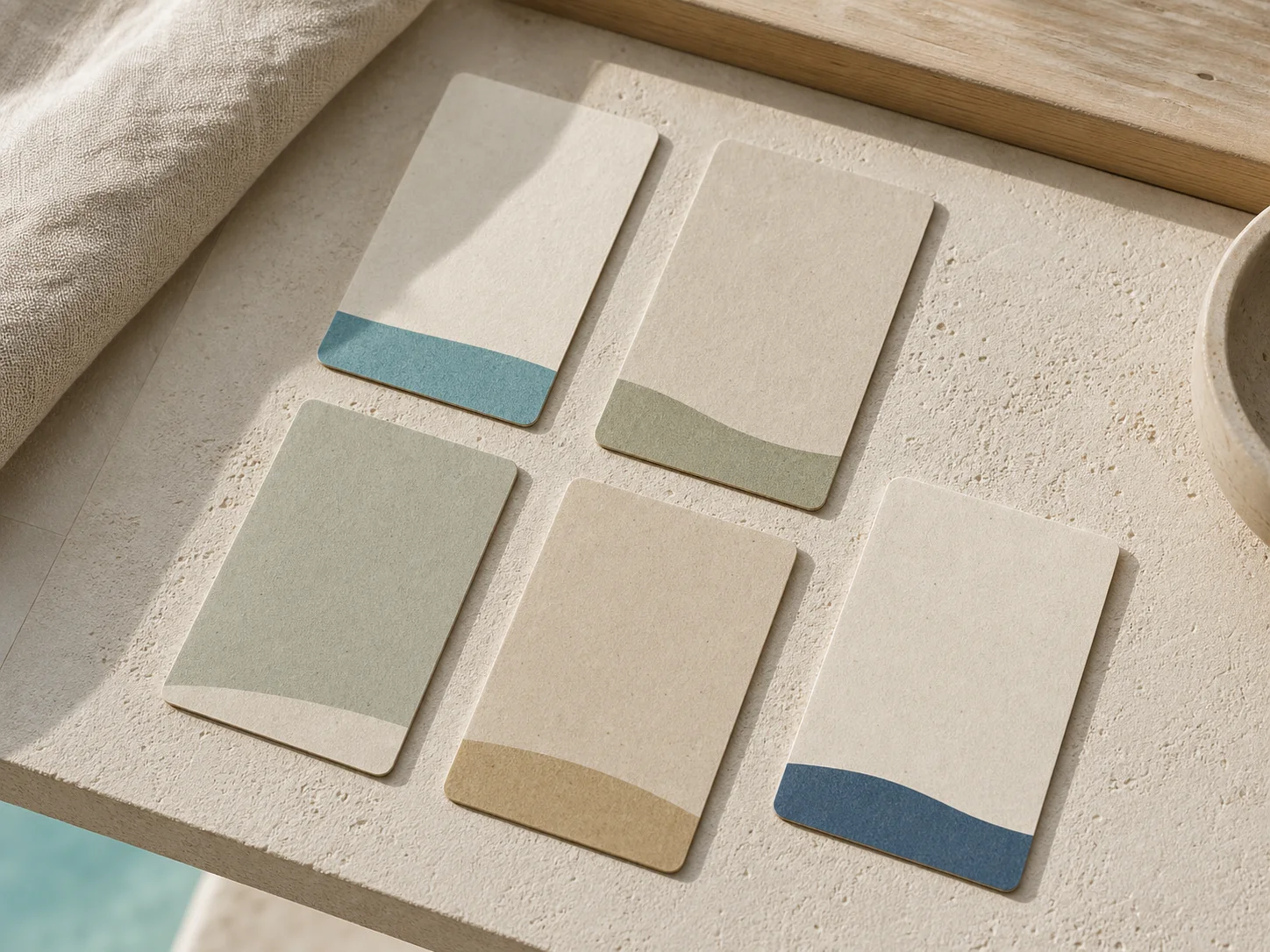
Three materials. Five views each.
Realistic image directions for comparison and artwork planning. Every final card construction, credential stack, material claim and operating limit remains subject to the approved specification and physical sample.
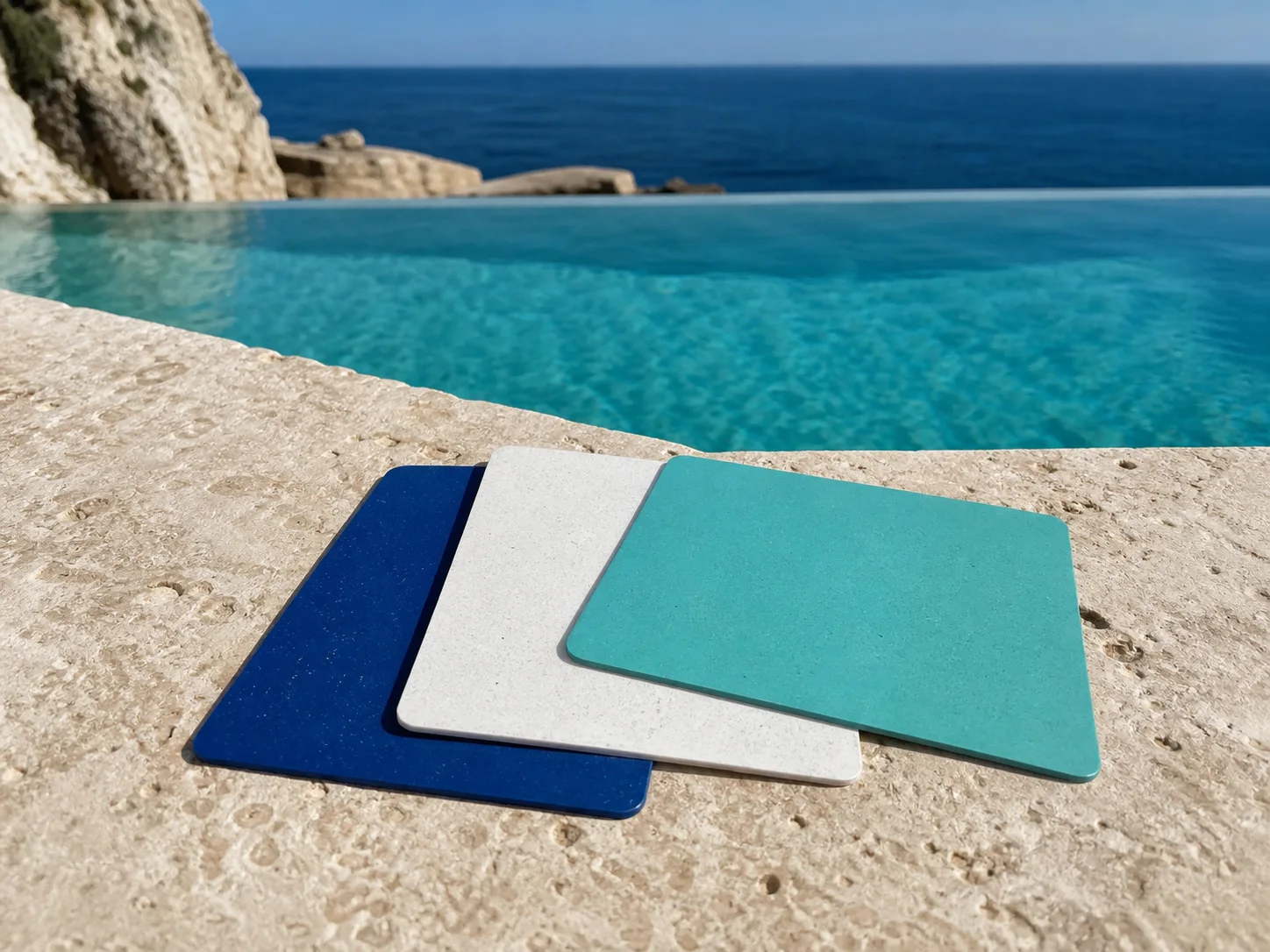
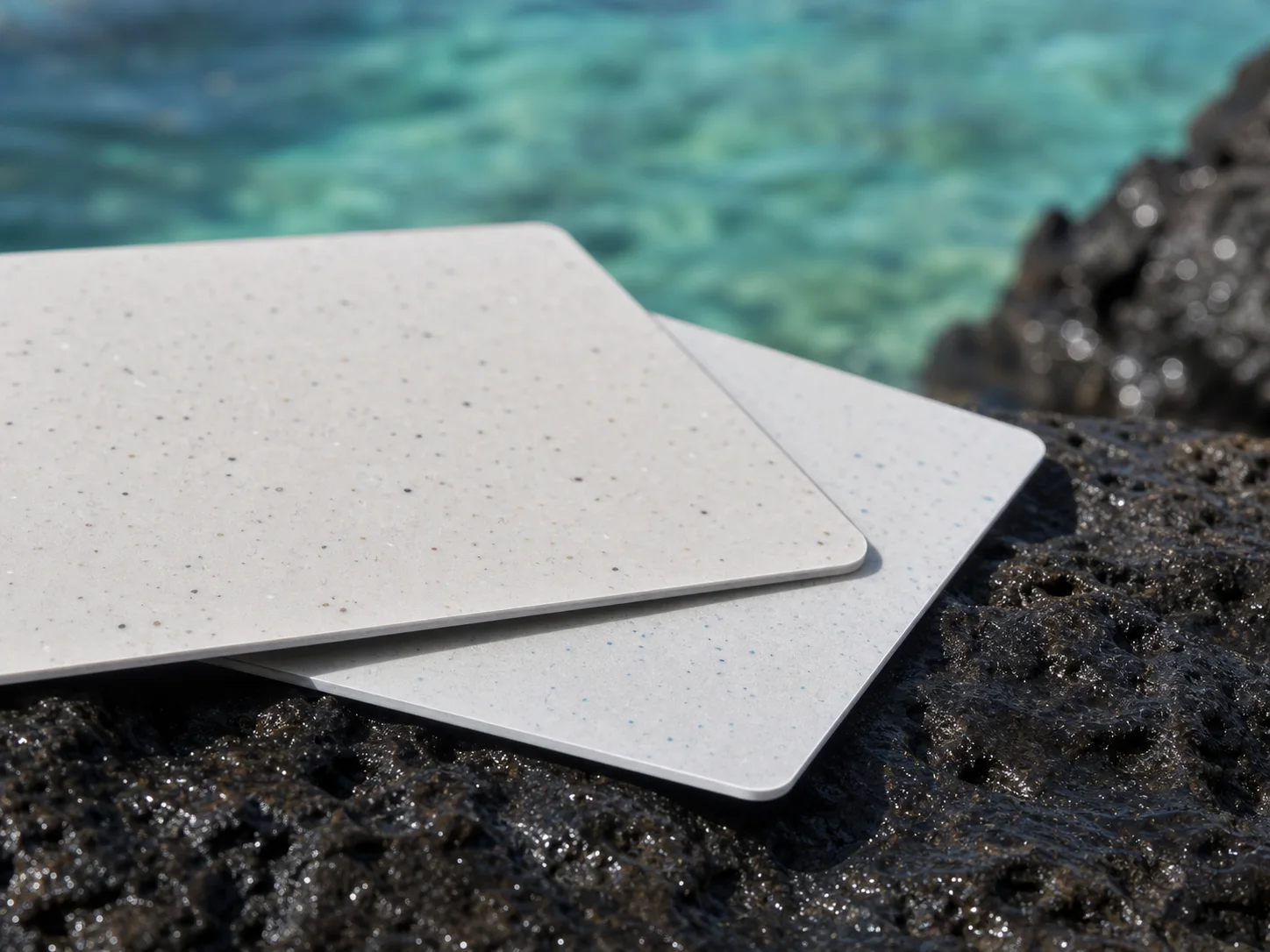
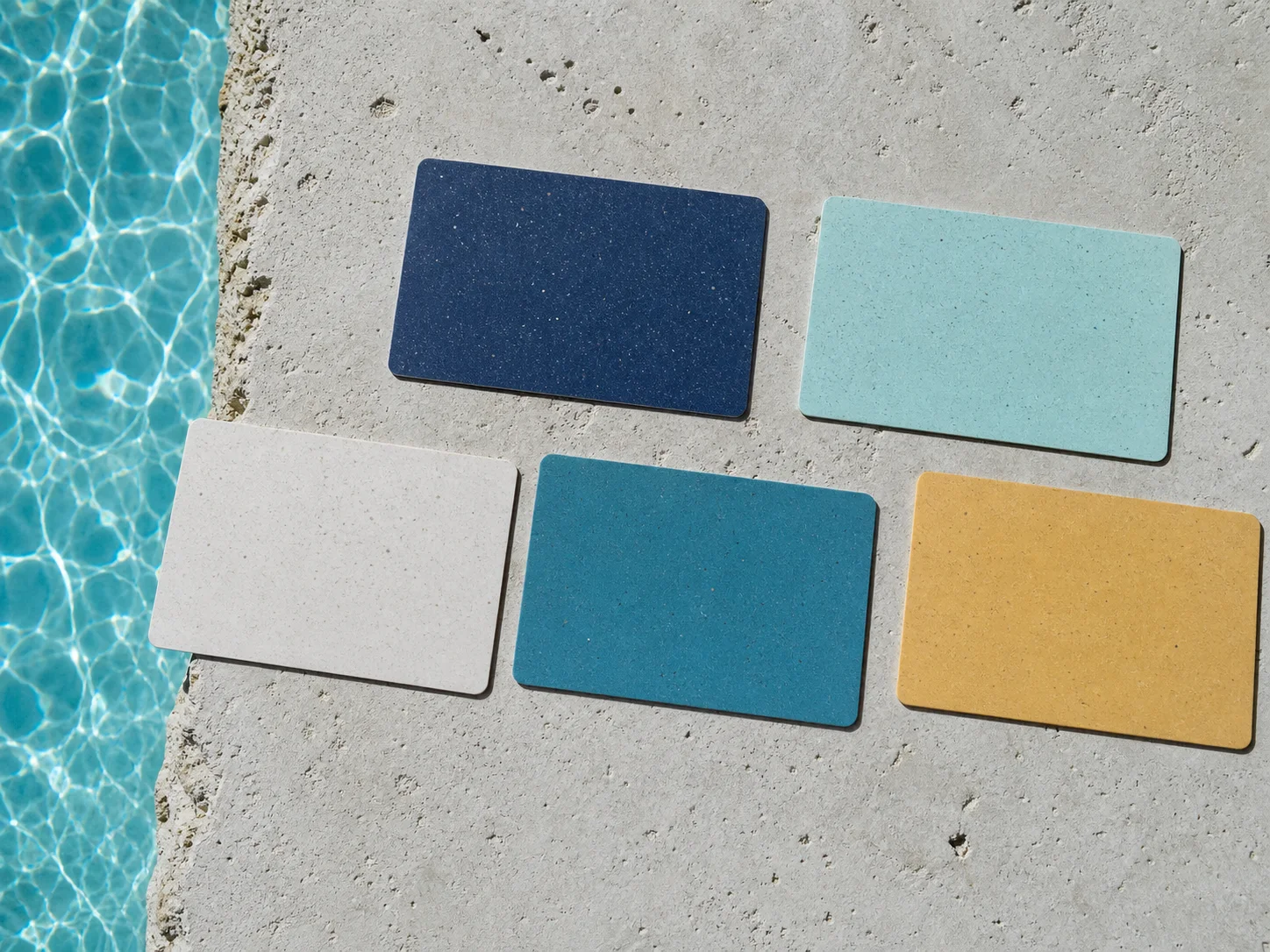
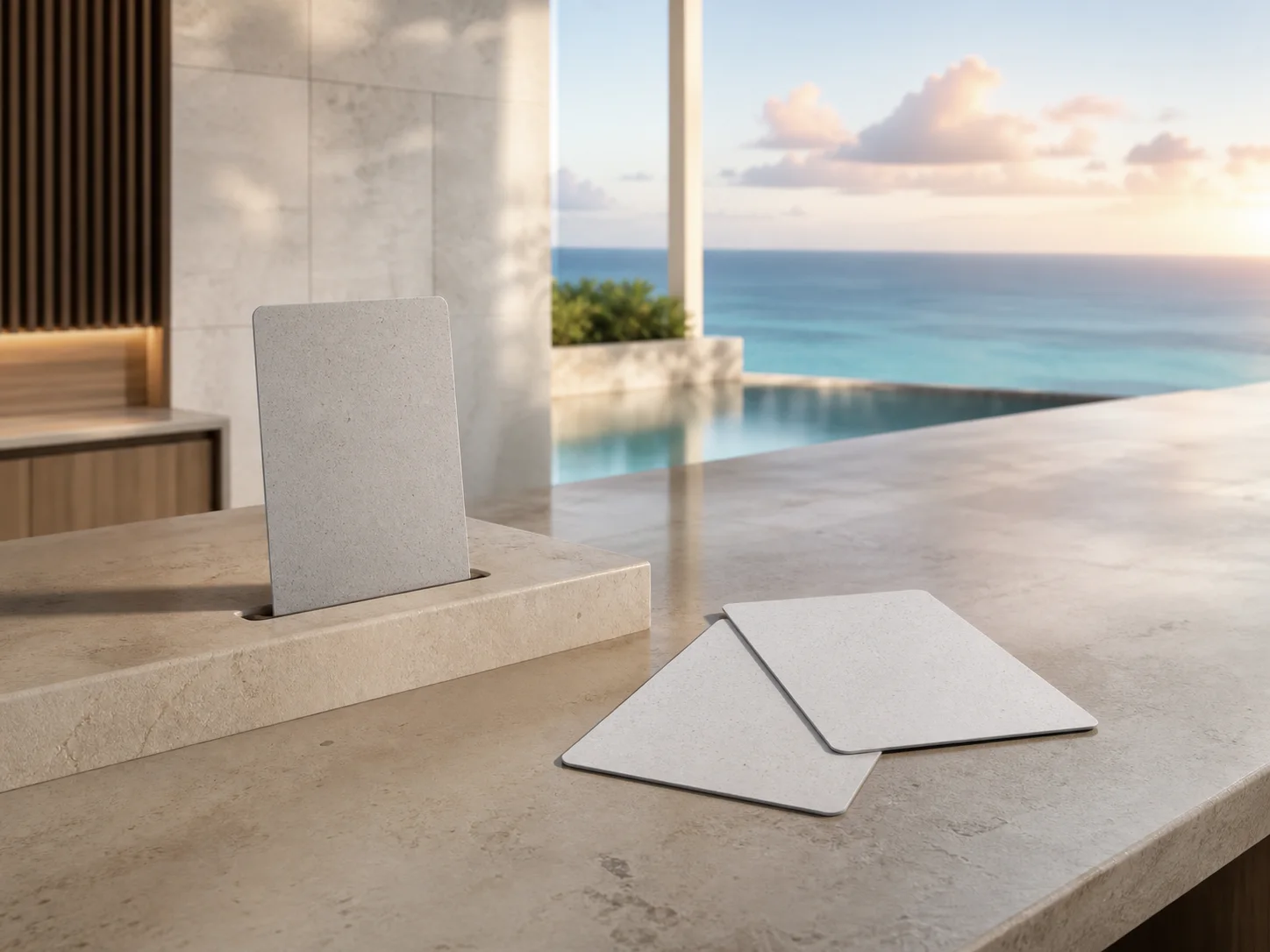
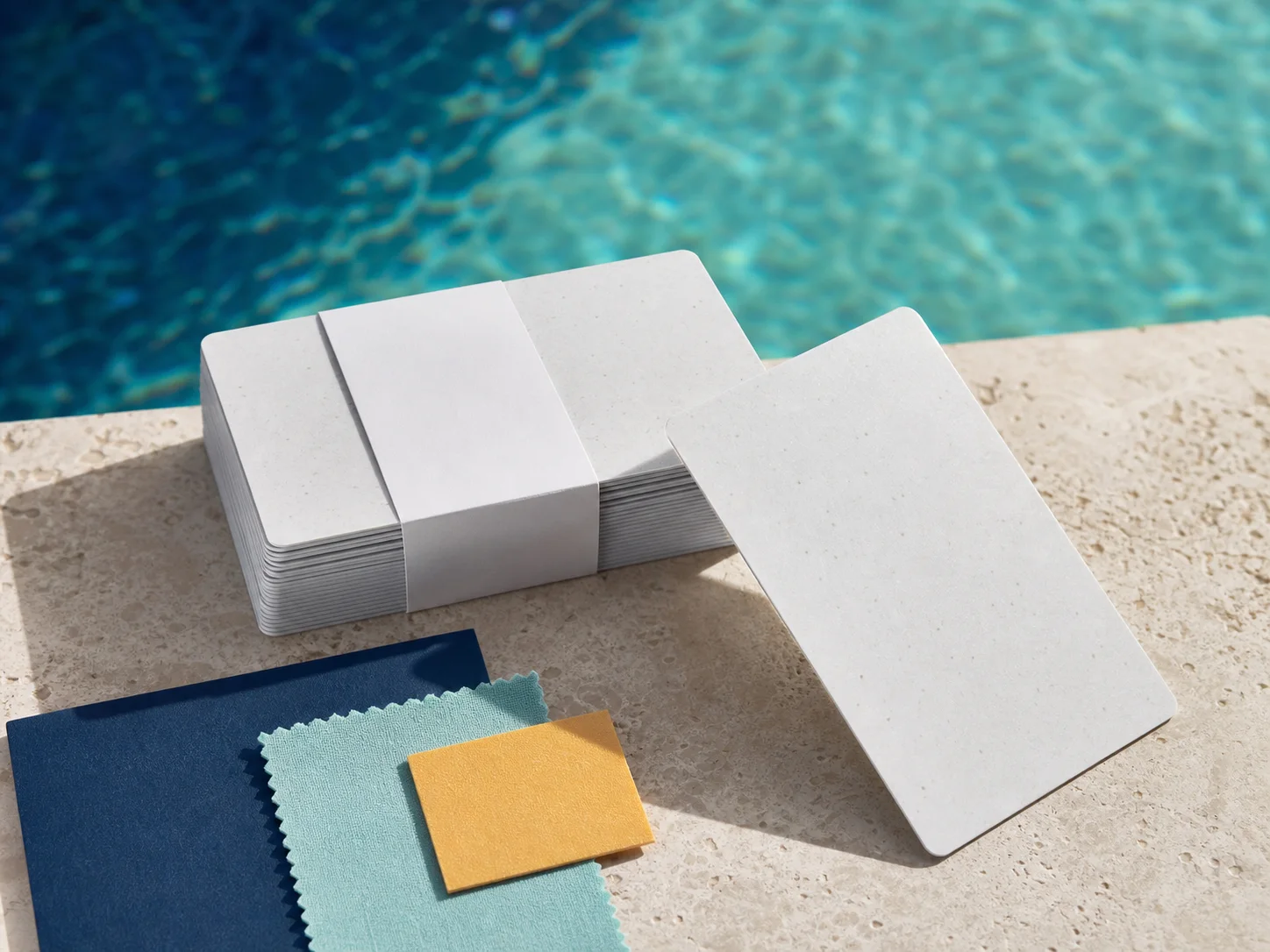
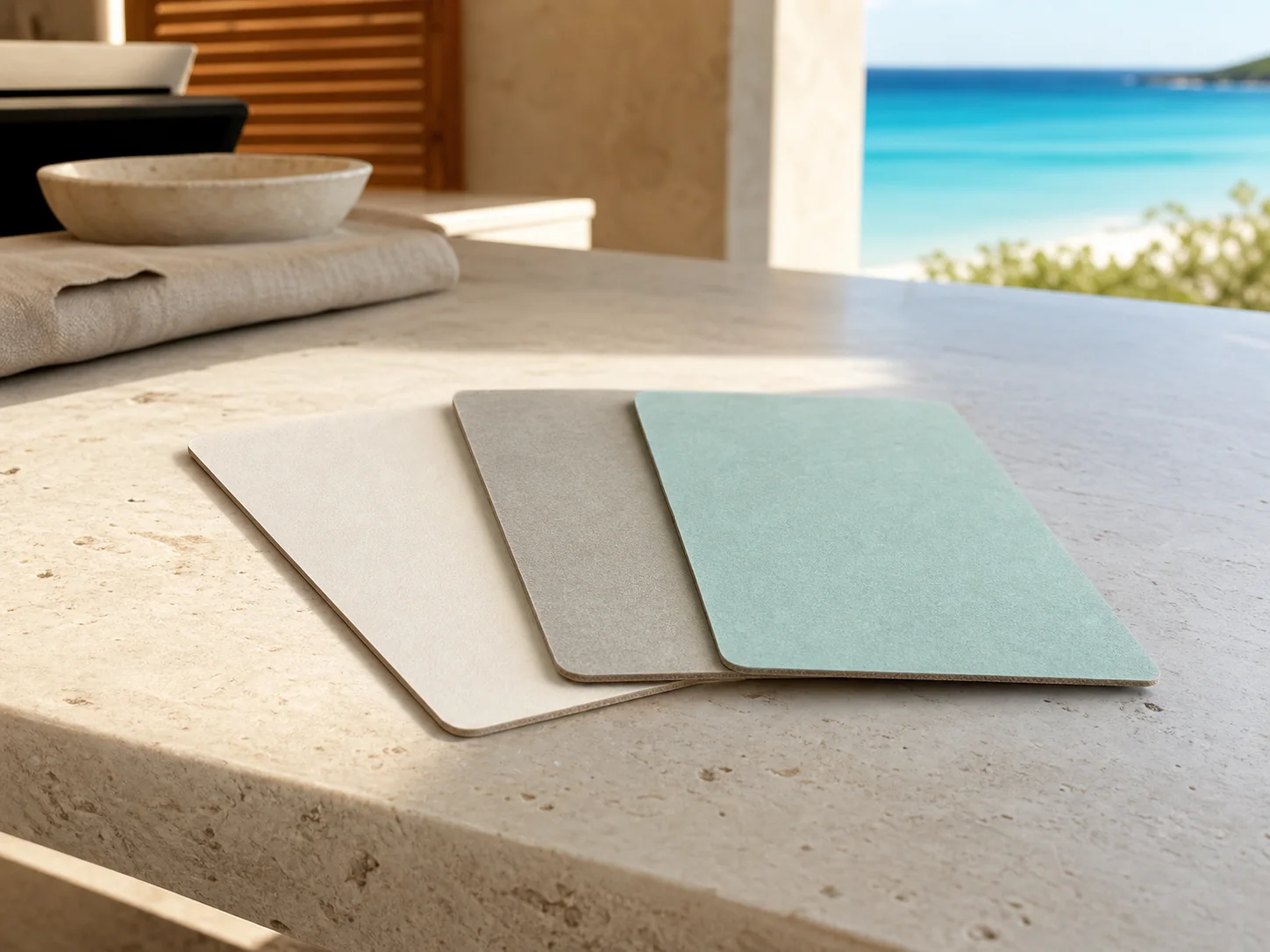
A familiar plastic-card handling direction with visible recycled-content character. Recycled content, source and end-of-life language must be supported by the approved supplier specification.
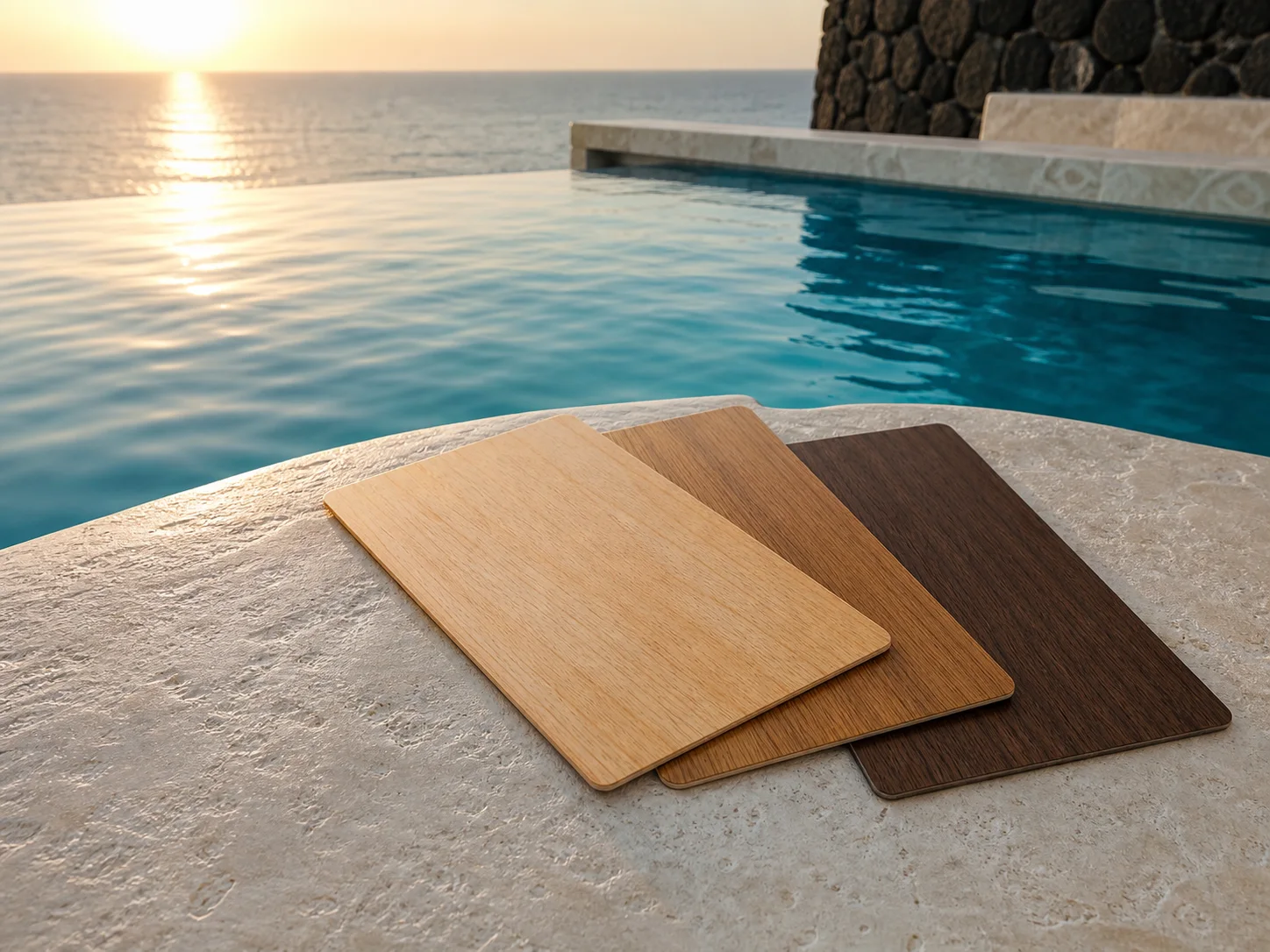
01Poolside material family02Edge and fleck macro03Caribbean colour study04Reception context05Production-review stack
MATERIAL / 02
Natural wood
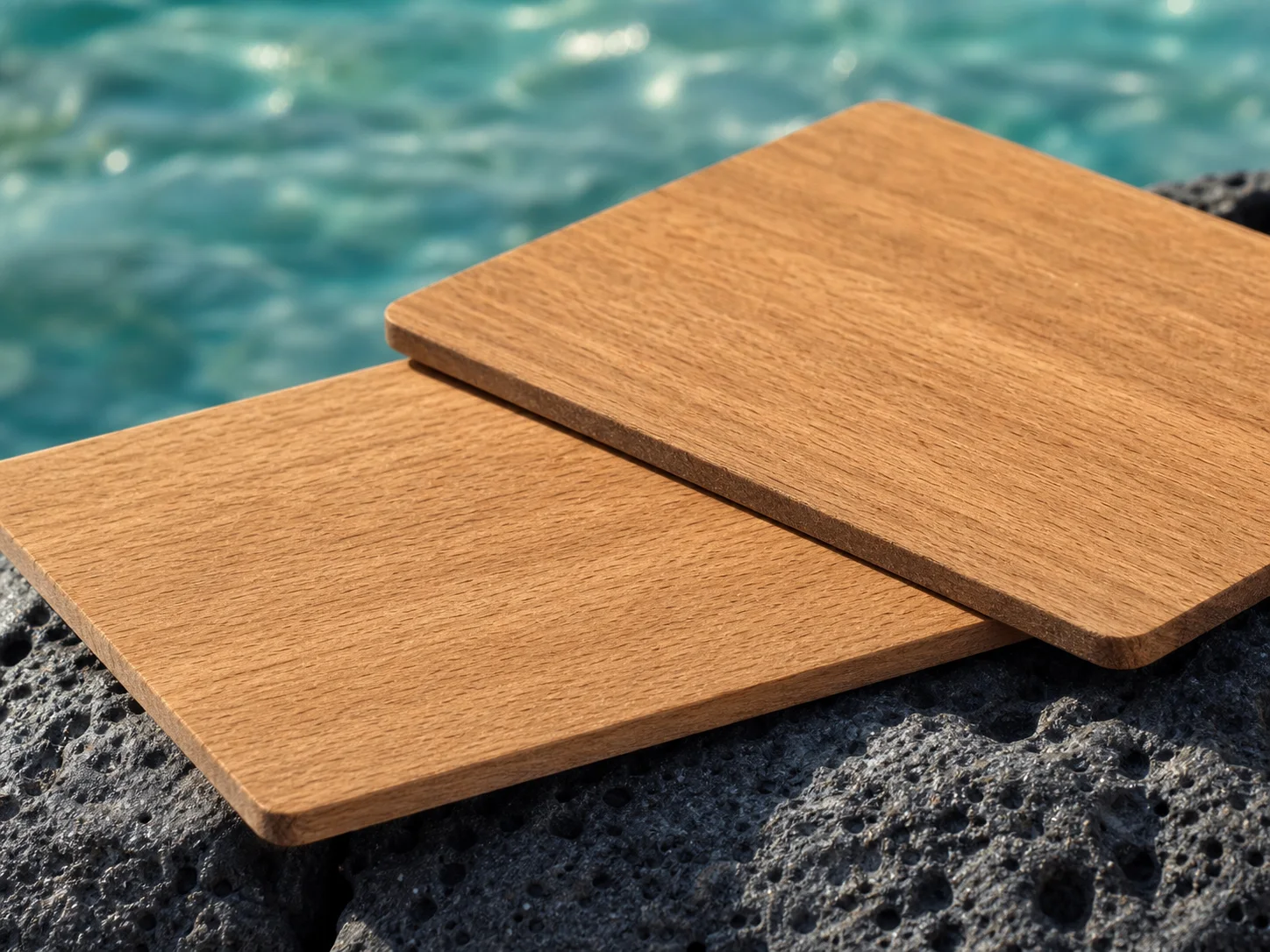
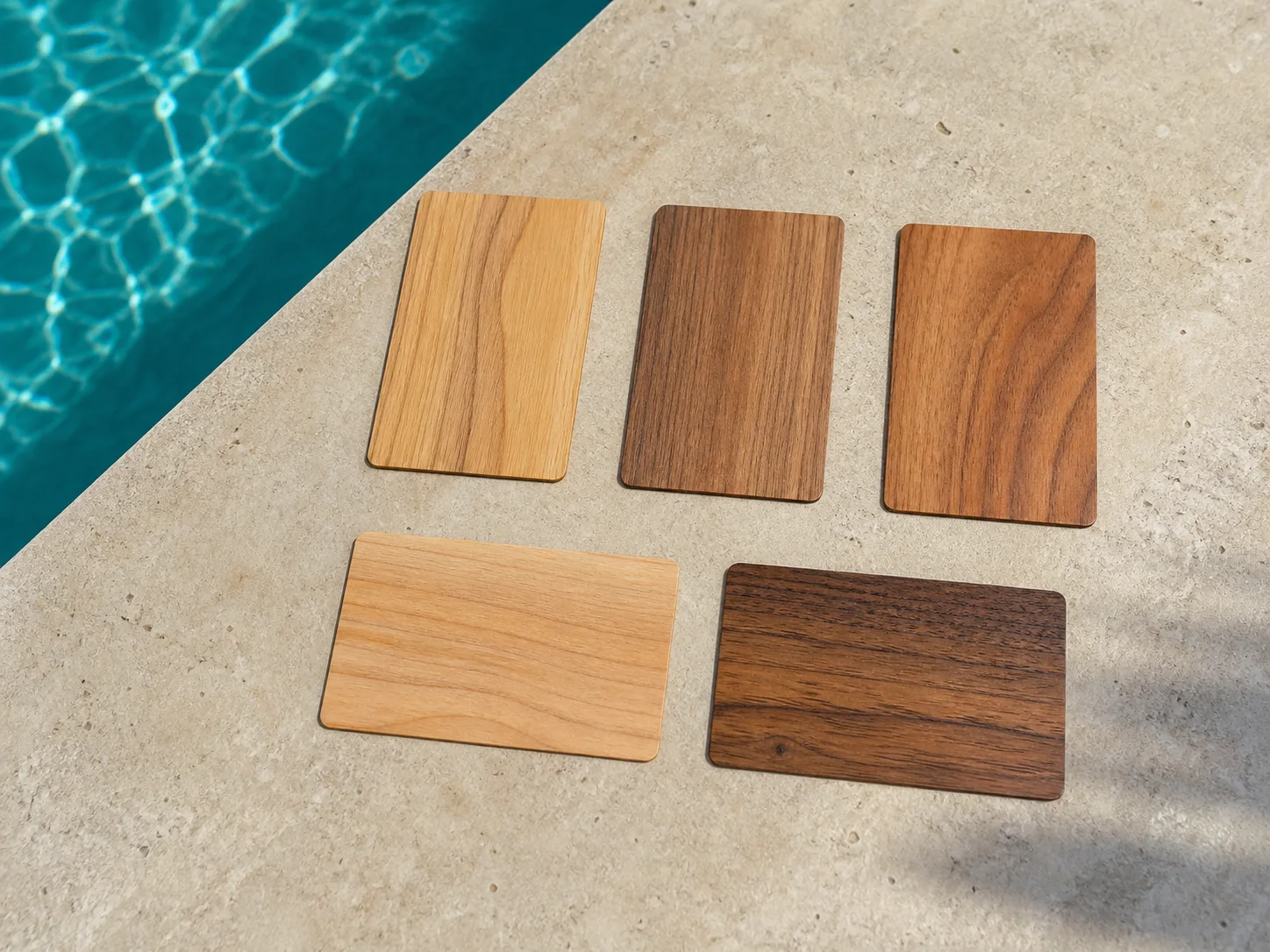
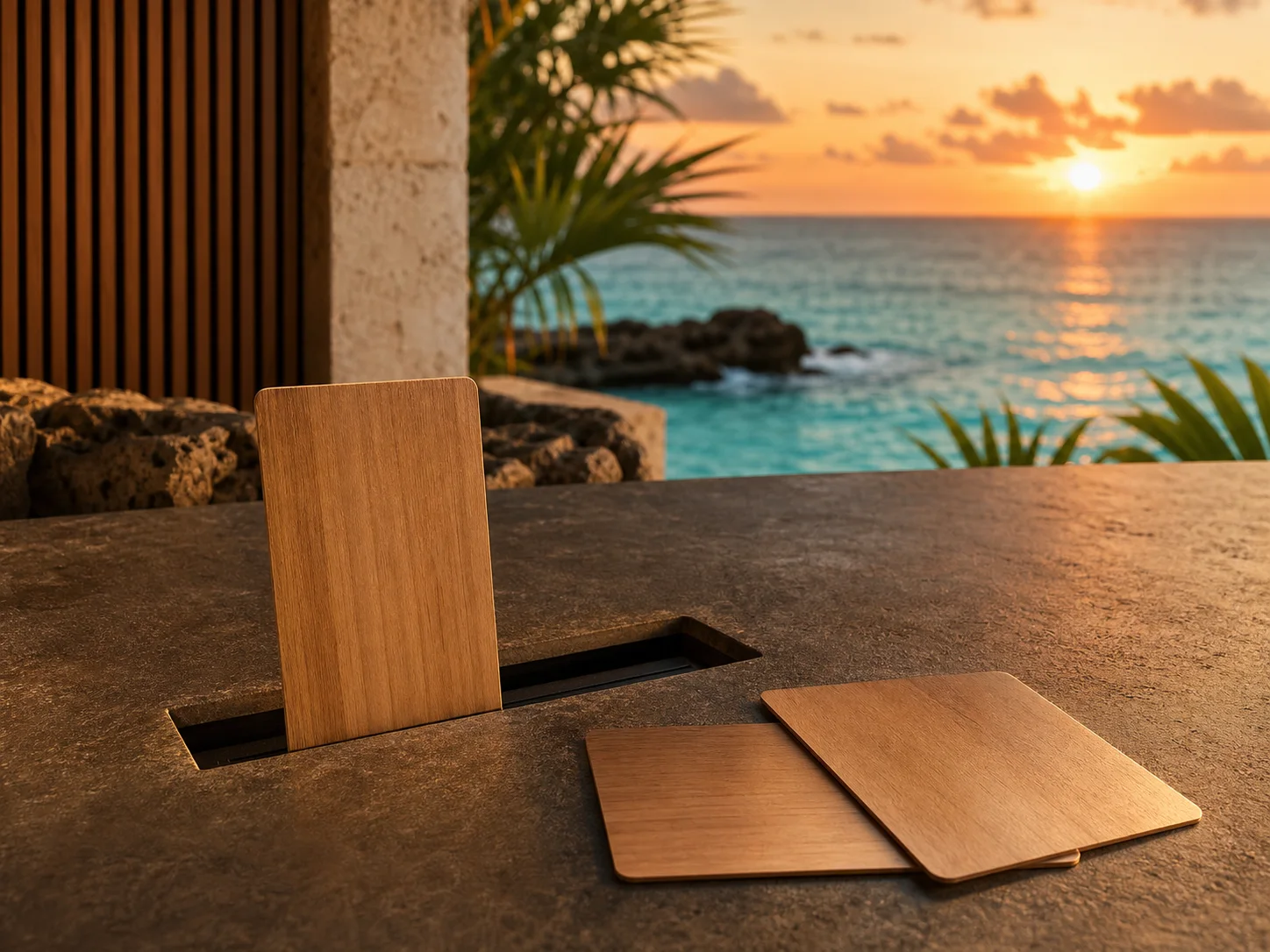
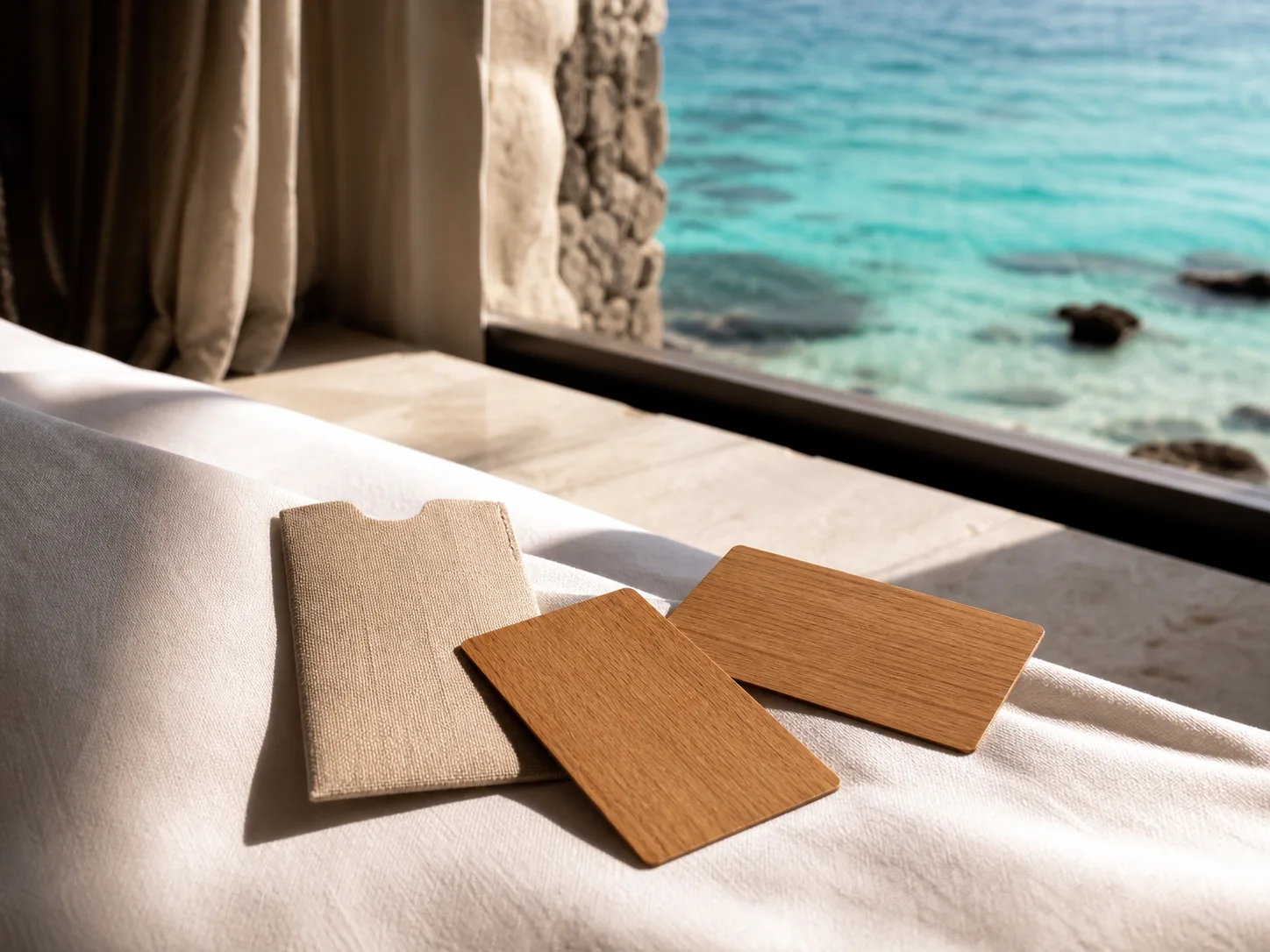
A tactile natural-grain direction. Wood species, construction, surface treatment, card thickness and operating compatibility require a physical sample and documented approval.
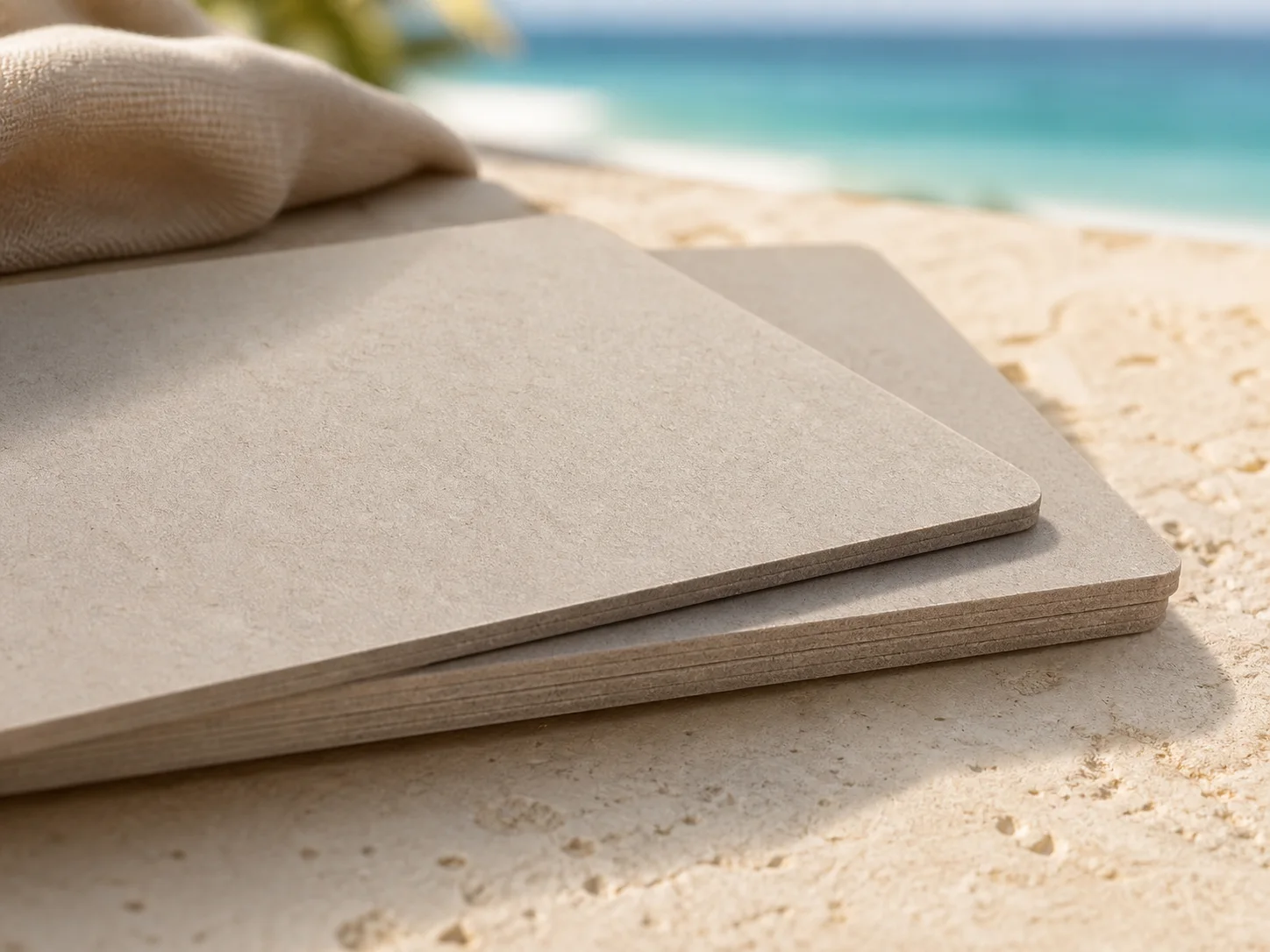
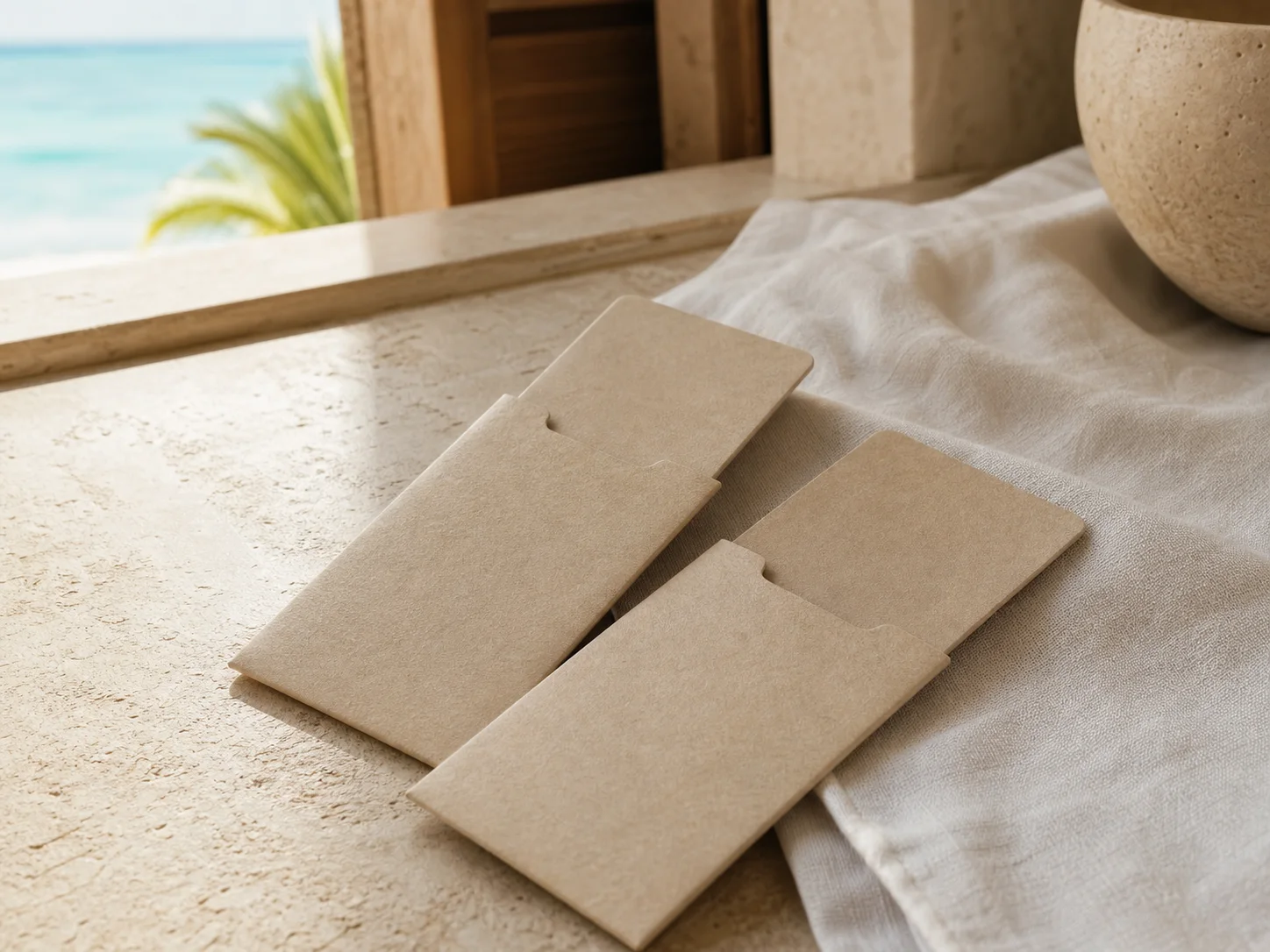
A compressed wood-pulp fibre direction for appropriately controlled programs. Fibre source, certification, recyclability, durability and operating limits remain document-dependent claims.
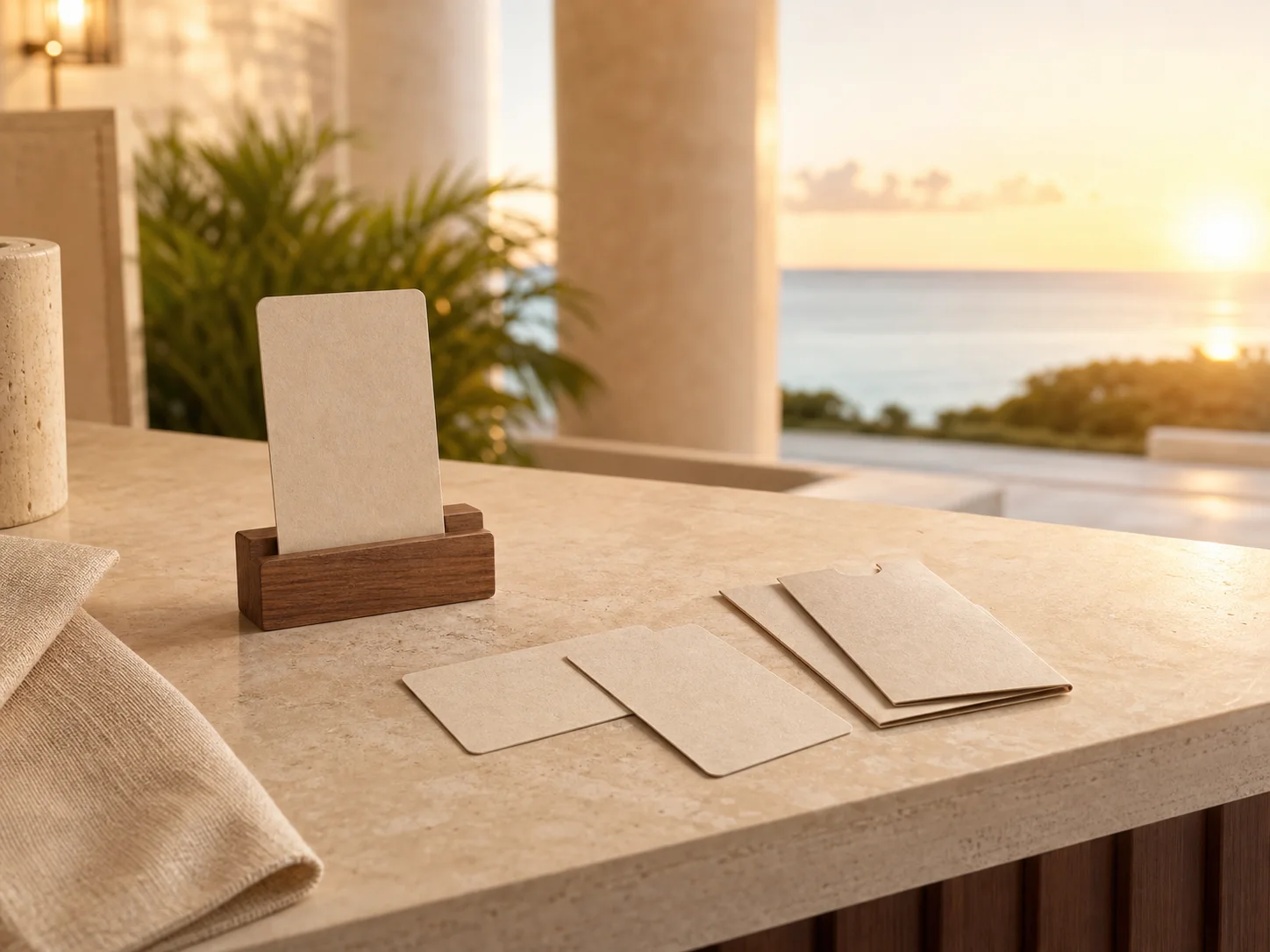
01Dry reception family02Compressed-fibre macro03Print and colour study04Coordinated sleeves05Reception issue set
How a hotel key card is released.
Material, print and proof are three separate approvals sitting on top of one confirmed credential decision.
01
Material direction
Choose the card body around handling, budget and approved sustainability goals.
02
Print control
Review colour, finish, orientation and variable fields before release.
03
Proof before production
Approve a product-specific proof rather than relying on a screen mock-up alone.
Start with the property, use case, destination and what is known about the installed access environment.
Three controls before release. Each stage is reviewed separately so an attractive product direction never substitutes for technical or operational confirmation.